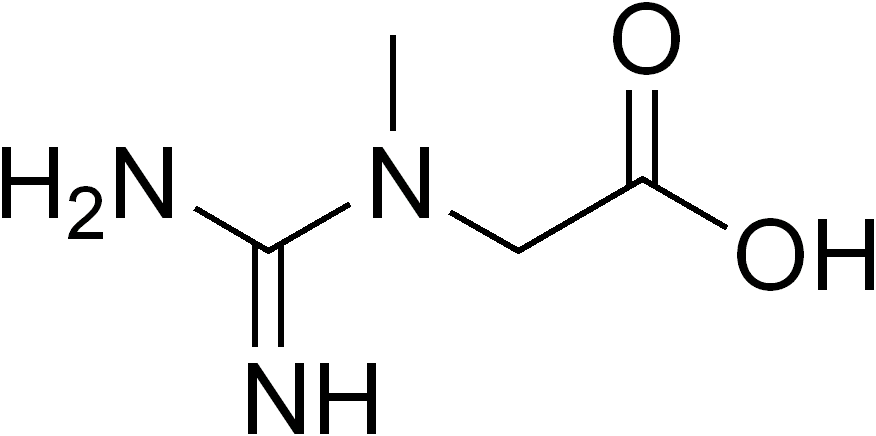
The simplest way to understand creatine is as a support system for ATP, the cell's immediately usable energy currency. A muscle contraction spends ATP. When demand becomes high, the body must regenerate it quickly. Creatine is stored in muscle as creatine and phosphocreatine, and the enzyme creatine kinase helps transfer energy between them.
Supplementing creatine changes the size of this local energy reserve. It does not make ATP appear from nowhere, burn more fat, or directly stimulate the nervous system. Its most useful effects follow from better ATP availability during demanding work and from allowing more high-quality training volume over time. Those distinctions keep the mechanistic story in line with human outcomes.
The phosphagen system recycles ATP rapidly
ATP is needed for many steps in muscle contraction, but the amount present at any moment is limited. During rapid changes in demand, phosphocreatine donates a phosphate group to ADP through creatine kinase, producing ATP and free creatine. This reaction belongs to the phosphagen system, the body's fastest immediate source of ATP. It matters most when an event is intense and brief, such as a heavy lift, a jump, or a 5- to 10-second sprint.
When phosphocreatine falls, energy from carbohydrate and fat oxidation takes over more of the load. That slower system can support longer work, but it cannot replace the instantaneous ATP transfer of phosphocreatine as neatly. More muscle creatine and phosphocreatine can therefore improve the capacity to repeat near-maximal efforts, especially when a workout gives little rest between demanding bouts.
More muscle creatine can improve repeated-effort capacity
Supplementation increases total muscle creatine in many people, which expands the reservoir available to the phosphagen system. The benefit is most evident when several high-intensity efforts occur before recovery is complete. A single dose taken immediately before lifting does not instantly fill the muscle; the more relevant change is a higher muscle store developed through repeated intake over days or weeks.
This mechanism helps explain why performance effects are clearer in repeated sprinting, interval work, and sets of heavy lifts than in prolonged steady-state exercise. It also explains why creatine is not a stimulant. It does not create alertness or mask fatigue in the way caffeine may. Instead, it helps cells handle ATP turnover, and any training benefit follows from better performance within repeated sessions.
Other proposed effects remain more qualified
Creatine is present in the brain as well as muscle, and researchers have examined cognition, fatigue, recovery, and several clinical conditions. These questions are not settled by the simple phosphagen explanation. Results can vary with age, baseline nutrient status, sleep deprivation, cognitive task, and health status, and the evidence is not equivalent to the extensive exercise-performance literature.
Creatine also tends to increase intracellular water during saturation. Some of the early body-weight gain may reflect this fluid change rather than new contractile tissue. Over time, any meaningful lean-mass gain is best interpreted alongside progressive resistance training and nutrition. Claims that creatine directly burns fat, replaces sleep, treats disease, or produces the same effects for every population should therefore be viewed cautiously.
| Point | Evidence-based context |
|---|---|
| What this guide covers | How Does Creatine Work? |
| Core takeaway | Creatine supports rapid ATP recycling through the phosphagen system. Here is how that mechanism relates to strength, repeated effort, and realistic expectations. |
| Evidence boundary | Most creatine studies involve healthy adults; read the limitations for population boundaries. |
| Source standard | 4 traceable scientific source(s) are listed with the article. |
Frequently asked questions
Is creatine an energy drink ingredient?
Creatine is an energy-system support nutrient, not a stimulant. It supports rapid ATP regeneration in muscle rather than increasing alertness like caffeine.
Why does creatine help repeated exercise more than endurance exercise?
The phosphagen system is most important when ATP demand changes suddenly and repeated bouts occur with limited recovery, as in heavy lifting, sprinting, and intervals.
Does extra creatine directly cause muscle growth?
No direct growth stimulus has been established. Creatine can support lean mass when it makes progressive resistance training more effective, but training and nutrition remain essential.
Limitations
- The ATP mechanism is well established, but it does not predict every outcome observed in human trials.
- Evidence for cognition and many clinical uses is less consistent than evidence for exercise performance.
- The size and quality of the literature vary by outcome and by participant characteristics.
References
International Society of Sports Nutrition position stand: safety and efficacy of creatine supplementation in exercise, sport, and medicine. — source record
Common questions and misconceptions about creatine supplementation: what does the scientific evidence really show? — source record
Effect of creatine supplementation on body composition and performance: a meta-analysis. — source record
Influence of age, sex, and type of exercise on the efficacy of creatine supplementation on lean body mass: A systematic review and meta-analysis of randomized clinical trials. — source record
Last updated: 2026-11-24