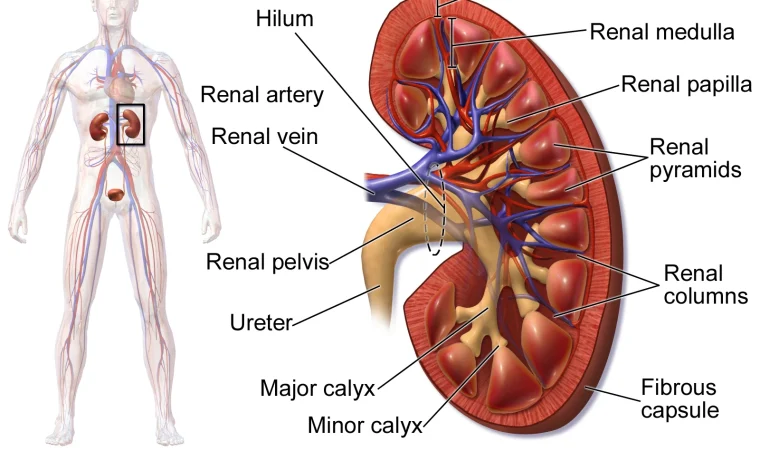
Kidney safety is the most persistent question around creatine, and it deserves precision. Two facts can seem contradictory: creatine can raise serum creatinine, yet controlled studies in healthy adults have generally not found corresponding loss of kidney function. The key is how kidney filtration is measured and which population is being studied. These data do not establish safety for someone who already has kidney disease.
Why serum creatinine can rise
Creatine is converted to creatinine, a waste product that the kidneys filter. Taking more creatine can increase the amount of creatinine in blood even when kidney tissue is not injured. Many kidney-function estimates use serum creatinine, so the arithmetic can make estimated glomerular filtration rate look lower. Glomerular filtration rate is the volume of plasma filtered by the kidneys; a creatinine-based estimate is an indirect calculation rather than a direct measurement of filtration.
This distinction can cause confusion when a lab value changes after a supplement starts. Other markers, repeated measurements, urine findings, and filtration methods that do not rely on serum creatinine may be useful in clinical assessment. The 2026 systematic review found a small average rise in serum creatinine in healthy active adults but identified very limited direct filtration data and rated the certainty low to very low. The result is compatible with no kidney harm, but it does not prove long-term renal safety by itself.
What evidence in healthy adults shows
Broad reviews of creatine supplementation report no consistent evidence of kidney injury in healthy adults at commonly studied doses. Many trials have followed participants for months, and some research has included people with stable disease or clinical conditions, which complicates interpretation. Safety findings are strongest when dose, duration, health status, and kidney-function methods are clearly described.
The limitations are important. Short trials cannot exclude every long-term effect; healthy participants may not represent people with reduced filtration; and creatinine-based estimates can obscure the underlying result. Reviews also often combine loading and nonloading regimens and different creatine forms. A careful conclusion is that available evidence does not show kidney damage in healthy adults, while the most important clinical question—use in established kidney disease—requires different evidence and individualized care.
Who should seek medical advice first
Anyone with chronic kidney disease, reduced kidney function, a prior acute kidney injury, urinary obstruction, recurrent kidney stones, or a condition affecting the kidneys should discuss creatine with a nephrologist or other qualified clinician before using it. The same is prudent for people taking medicines that may affect kidney function. A supplement decision should be based on the person's actual condition and laboratory results, not on a general review of healthy adults.
People who use creatine should tell the clinician when routine labs are ordered. If kidney function is being assessed, the clinician may want repeat testing or a measure of filtration that is independent of serum creatinine. Seek prompt care for reduced urine output, swelling, persistent vomiting, severe weakness, confusion, or other acute symptoms. These symptoms require evaluation and should not be self-diagnosed as a creatine side effect.
| Point | Evidence-based context |
|---|---|
| What this guide covers | Creatine and Kidney Health: What Healthy Adults Should Know |
| Core takeaway | Creatine can change serum creatinine without necessarily indicating kidney injury, so accurate interpretation matters; people with kidney disease should consult a clinician before supplementing. |
| Evidence boundary | Most creatine studies involve healthy adults; read the limitations for population boundaries. |
| Source standard | 4 traceable scientific source(s) are listed with the article. |
Frequently asked questions
Does creatine raise creatinine because it damages the kidneys?
Not necessarily. Creatine is converted to creatinine, and higher creatine intake can raise serum creatinine without kidney injury. The change can make creatinine-based filtration estimates look lower, so interpretation by a clinician is important.
Is creatine safe if I have kidney disease?
Do not assume it is safe. Most evidence concerns healthy adults, and people with kidney disease may metabolize and excrete substances differently. Ask the clinician managing the condition before starting or changing a supplement.
Should I stop creatine before blood work?
Tell the clinician that you take creatine and follow their instructions about timing. Do not independently stop a medically important supplement or treatment; repeat results or alternative filtration measures may be useful for accurate interpretation.
Limitations
- Direct measurement of glomerular filtration independent of creatinine is limited in the creatine literature.
- Most data concern healthy adults and do not establish safety in impaired kidney function.
- Safety recommendations for kidney disease must be individualized; this article does not diagnose or treat kidney conditions.
References
Creatine supplementation and kidney function in healthy, physically active adults: a systematic review and meta-analysis and the evidence gap in directly measured glomerular filtration — source record
Common questions and misconceptions about creatine supplementation: what does the scientific evidence really show? — source record
Part II. Common questions and misconceptions about creatine supplementation: what does the scientific evidence really show? — source record
International Society of Sports Nutrition position stand: safety and efficacy of creatine supplementation in exercise, sport, and medicine. — source record
Last updated: 2026-11-24